
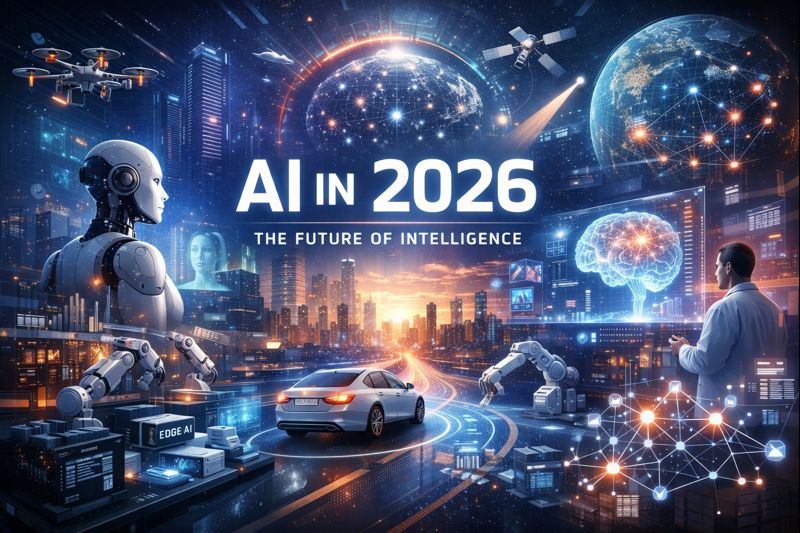
AI in 2026: The Technologies That Will Define the Next Decade

Artificial intelligence in 2026 has moved beyond experimentation and hype. It has become a foundational technology shaping how businesses operate, how decisions are made, and how industries evolve.
The technologies emerging this year are not just incremental improvements—they are setting the direction for the next decade of AI-driven transformation.
One of the most defining trends is multimodal AI. Unlike earlier systems that processed only text or images, AI in 2026 can seamlessly understand and generate across text, audio, video, images, and structured data. This allows businesses to build unified AI experiences across customer support, marketing, analytics, and operations.
Another key technology is the rise of autonomous AI agents. These systems don’t simply respond to prompts—they plan, execute tasks, evaluate outcomes, and improve without constant human input. Autonomous agents are now being used for sales follow-ups, workflow orchestration, customer service escalation, and internal operations management.
Edge AI is also defining the decade ahead. By processing data directly on devices instead of relying solely on the cloud, organizations gain faster decision-making, lower latency, improved privacy, and reduced infrastructure costs. This is especially impactful in healthcare, manufacturing, logistics, and smart cities.
In parallel, synthetic data generation has become critical. As privacy regulations tighten and real-world data becomes harder to access, synthetic data allows AI models to train safely, ethically, and at scale while maintaining performance.
Finally, AI governance and explainability layers are no longer optional. Businesses are investing in systems that ensure transparency, accountability, and regulatory compliance—laying the groundwork for sustainable
AI adoption.
Together, these technologies signal a shift: AI is no longer a tool for experimentation. In 2026, it is the infrastructure shaping the future of work, innovation, and competitive advantage.
From Hype to Infrastructure: How AI Became Business-Critical in 2026
For years, artificial intelligence was treated as an innovation experiment—something exciting, but optional. In 2026, that mindset has changed completely. AI is now business infrastructure, as essential as cloud computing or cybersecurity.
The turning point came when organizations realized AI was no longer just improving efficiency—it was running core operations. AI systems are embedded directly into CRMs, ERPs, marketing platforms, customer support tools, and financial forecasting engines. Without AI, these systems simply can’t compete.
One major shift is reliability. Early AI tools were impressive but inconsistent. Today’s enterprise AI is built for uptime, scalability, and predictability. Businesses now invest in AI infrastructure, not one-off tools—prioritizing data pipelines, model orchestration, and governance frameworks.
Budget allocation reflects this change. AI is no longer categorized as experimental R&D spending. Instead, it sits within operational budgets, directly tied to revenue growth, cost reduction, and customer experience improvements. AI downtime is now treated with the same seriousness as server outages.
Another factor driving AI’s infrastructure role is competition. Companies that failed to integrate AI into their workflows are being outpaced by AI-first competitors who move faster, personalize better, and make smarter decisions in real time.
In 2026, the question is no longer “Should we use AI?” It’s “Can our business function without it?” Organizations that treat AI as infrastructure—not hype—are the ones positioned to lead in the years ahead.
The Rise of Autonomous AI Systems: What Comes After Automation
Automation was only the beginning. In 2026, businesses are entering a new phase: autonomous AI systems that go beyond predefined workflows and operate with real independence.
Traditional automation relies on rules and triggers—if X happens, do Y. Autonomous AI systems, by contrast, understand goals, analyze context, make decisions, and take action without continuous human instruction. They don’t just execute tasks; they manage outcomes.
These systems are already transforming industries. In sales, autonomous agents qualify leads, send personalized follow-ups, book meetings, and adjust messaging based on response rates. In operations, they manage schedules, allocate resources, and resolve bottlenecks in real time. In customer support, they handle full conversations, escalate issues intelligently, and learn from customer feedback.
What makes this shift possible is the convergence of large language models, memory systems, real-time data access, and feedback loops. Autonomous AI can now evaluate its own performance and improve without manual retraining.
However, autonomy doesn’t mean the removal of humans. Instead, roles are shifting. Humans move from task execution to oversight, strategy, and exception handling. The most successful organizations in 2026 design systems where humans supervise outcomes rather than manage every step.
As automation gives way to autonomy, businesses that embrace this transition will gain speed, scalability, and resilience—while those clinging to rigid workflows risk falling behind.
Why 2026 Is the Year AI Stops Assisting and Starts Deciding
In previous years, AI assisted humans by offering recommendations and insights. In 2026, a fundamental shift is underway: AI is now making decisions.
This transition is driven by the rise of decision intelligence systems—AI models trained not just to analyze data, but to choose optimal actions based on goals, constraints, and probabilities. These systems are now responsible for pricing adjustments, fraud detection, lead prioritization, inventory management, and resource allocation.
What changed? Trust and accuracy. AI models in 2026 are significantly more reliable, auditable, and context-aware. Combined with real-time data and governance frameworks, organizations are increasingly comfortable allowing AI to act autonomously within defined boundaries.
This has led to a new operating model: human-on-the-loop instead of human-in-the-loop. Humans no longer approve every decision but monitor performance, review exceptions, and set strategic direction.
Of course, this shift raises important questions around accountability, ethics, and transparency. That’s why explainable AI and audit trails are now standard components of decision-making systems.
The reality is clear: AI-driven decisions are faster, more consistent, and often less biased than human-only alternatives. In 2026, competitive advantage belongs to organizations that know when to let AI decide—and when humans must remain in control.
No responses yet