
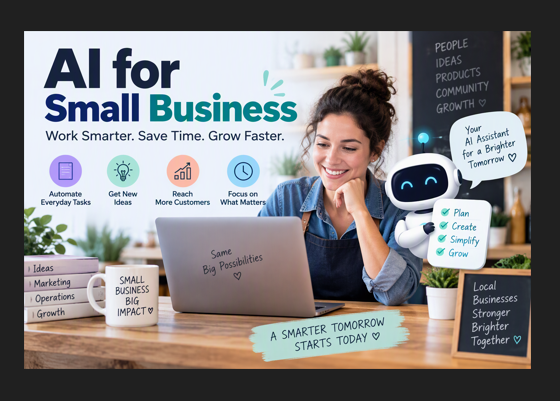
AI Weekly Insights: AI for Small Business
7 Ways Small Businesses Can Use AI to Save Time Every Week
Running a small business means wearing many hats. You are the marketer, the customer support team, the bookkeeper, and the scheduler, often in the same afternoon. This is where AI for small business helps most: it takes over repetitive tasks so you can focus on work that grows revenue.
You don’t need a big budget or a technical background. Many AI tools are affordable, easy to set up, and built for non-experts. Here are seven practical places to start.
1. Draft emails faster
AI writing assistants can produce first drafts of replies, quotes, and follow-ups in seconds. You still review and personalize the message, but you skip the blank-page problem. Teams often save an hour or more each day this way.
2. Automate scheduling
Booking calls and appointments creates endless back-and-forth. AI-powered scheduling tools check your calendar, offer open slots, and send reminders automatically, which also reduces no-shows.
3. Summarize meetings and documents
Instead of rereading long threads or reports, ask AI for a short summary with key decisions and next steps. Meeting-note tools can also record and organize action items for you.
4. Handle common customer questions
Many customer questions repeat: store hours, pricing, shipping, and return policies. An AI assistant can answer these instantly and pass complex cases to you.
5. Create content ideas and outlines
Struggling with what to post this week? AI can suggest blog topics, social captions, and email subject lines based on your products and audience. Treat the output as a starting point and add your own voice and experience.
6. Organize your finances
Modern accounting tools use AI to categorize expenses, flag unusual transactions, and prepare simple cash flow reports. This makes month-end less stressful and helps you spot problems early.
7. Analyze data without a data team
Upload a sales spreadsheet and ask plain-language questions such as “Which product sold best last quarter?” AI can surface patterns that would take hours to find manually.
Tips for getting started
- Pick one task. Start with the process that eats the most time.
- Keep a human in the loop. Always review AI output before it reaches a customer.
- Protect sensitive data. Avoid pasting private customer or financial details into tools you haven’t vetted.
- Measure results. Track hours saved so you know whether the tool is worth paying for.
Final thoughts
AI won’t replace the personal touch that makes small businesses special. It handles the routine work so you have more time for customers, creativity, and strategy. Choose one task this week, test one tool, and build from there.
AI Chatbots for Small Business: Benefits, Costs, and How to Choose
Customers expect fast answers, often outside business hours. For a small team, that expectation is hard to meet. An AI chatbot for small business can help by responding instantly, day or night, and freeing you from repetitive questions.
What an AI chatbot actually does
Today’s chatbots go well beyond rigid scripts. They understand natural language, pull answers from your website or help documents, and hold a conversation that feels helpful. They can answer FAQs, collect lead details, book appointments, and direct customers to the right page or person.
Key benefits
- 24/7 availability. Customers get answers even when you’re asleep or busy.
- Faster response times. Quick replies improve satisfaction and can keep a buyer from leaving.
- Lead capture. A chatbot can ask for a name and email, then pass the lead to your CRM.
- Lower support workload. Routine questions are handled automatically, so your team focuses on complex issues.
- Consistent answers. The bot shares the same accurate policy information every time.
What does it cost?
Pricing varies widely. Many platforms offer free or low-cost starter plans, while advanced features such as integrations, multiple channels, and higher conversation volumes cost more. Check whether pricing is per seat, per conversation, or flat monthly, and ask about extra fees before you commit.
How to choose the right chatbot
- Define your goal. Is it support, lead generation, or bookings? Choose a tool built for that job.
- Check integrations. It should connect with your website, CRM, calendar, and email tools.
- Test the training process. You should be able to feed it your own FAQs and policies easily.
- Look for human handoff. The bot must pass frustrated or complex customers to a real person.
- Review privacy practices. Understand how customer data is stored and used.
Common mistakes to avoid
- Launching without testing. Ask the bot your toughest questions before going live.
- Hiding the human option. Customers get annoyed when they can’t reach a person.
- Never updating it. When prices or policies change, update the bot’s knowledge too.
- Overpromising. Tell users clearly that they’re chatting with an AI assistant.
Final thoughts
A well-configured chatbot acts like a friendly front desk that never takes a day off. Start small with your top ten customer questions, review the conversations weekly, and keep improving. The goal isn’t to replace human service. It’s to make sure every customer gets a quick, helpful first response.
AI Marketing Tools for Small Business: Create More Content on a Budget
Consistent marketing builds trust and brings in customers, but it takes time most small business owners don’t have. AI marketing tools for small business make it possible to publish more, stay consistent, and keep costs reasonable.
Plan content with less guesswork
AI can help you build a monthly content calendar. Describe your business, audience, and goals, and it can suggest topics, formats, and posting schedules. Ask it to group ideas into themes such as education, behind-the-scenes, customer stories, and promotions so your feed stays balanced.
Write first drafts quickly
Blog posts, product descriptions, social captions, and ad copy all start with a draft. AI can produce one in minutes. Then add what AI can’t supply: your real stories, local knowledge, customer results, and personality. Content that blends AI speed with human experience performs better and feels more authentic.
Improve your SEO
AI tools can suggest keywords, outline articles around what searchers want, and recommend improvements to titles and meta descriptions. They can also help you spot gaps, such as questions your customers ask that your website doesn’t answer yet. Remember that search engines reward helpful, original content, so avoid publishing generic text without editing.
Personalize email marketing
Email still delivers strong returns for small businesses. AI can help you write subject lines, segment your list by interest or purchase history, and choose better send times. Even small personalization, such as mentioning a customer’s last purchase, can lift engagement.
Repurpose what you already have
One blog post can become several social posts, a short email, a video script, and a customer FAQ. AI is excellent at reformatting content for different channels, helping you get more value from every idea.
Design and visuals
Many design platforms now include AI features for layouts, backgrounds, and image editing. These help non-designers produce clean graphics for posts, flyers, and ads in minutes.
Best practices
- Keep your brand voice consistent. Give the AI examples of your tone and words to avoid.
- Fact-check everything. AI can state incorrect details with confidence.
- Be transparent where needed. Follow platform rules and local regulations about disclosing AI use, especially for ads and images.
- Track performance. Look at clicks, replies, and sales to see what works, then adjust.
Final thoughts
You don’t need a large agency to market effectively. With the right AI tools and a simple weekly routine, a small team can show up consistently and professionally. Start with one channel, such as email or your blog, and expand as you see results.
How to Start Using AI in Your Small Business: A Simple 30-Day Plan
Many owners are curious about AI but unsure where to begin. The good news is that starting with AI in your small business doesn’t require a big overhaul. A focused 30-day plan lets you test, learn, and decide what’s worth keeping.
Week 1: Find your biggest time drains
List your weekly tasks and mark the ones that are repetitive, rule-based, or text-heavy. Common candidates include answering emails, writing posts, scheduling, data entry, and invoice follow-ups. Pick one task that costs you the most time. Write down how long it currently takes, because that is your baseline.
Week 2: Choose and test a tool
Look for tools designed for your chosen task. Before paying, compare:
- Ease of use and setup time
- Pricing and free trial options
- Integrations with software you already use
- Privacy and data handling policies
Run a small pilot using real but non-sensitive examples. Compare the AI result with your usual output for quality and speed.
Week 3: Build a simple workflow
Decide how the tool fits into your day. For example: AI drafts a reply, you review and edit it, then send. Write the steps down so a team member can follow them. Create short guidelines covering:
- What AI may and may not be used for
- What data must never be entered
- Who reviews AI output before it goes public
Clear rules keep quality high and protect your customers.
Week 4: Measure and decide
Now compare results to your Week 1 baseline. Ask:
- How many hours did we save?
- Did quality stay the same or improve?
- Did customers react positively?
- Is the tool worth its monthly cost?
If the answer is yes, keep going and consider your next task. If not, try a different tool or change the workflow instead of giving up on AI entirely.
Common risks and how to manage them
- Inaccurate output. Always review facts, numbers, and claims.
- Privacy concerns. Don’t share confidential data with tools you haven’t vetted.
- Over-reliance. Keep your own judgment and creativity in the loop.
- Team resistance. Explain that AI is there to remove boring work, not replace people, and invite feedback.
Final thoughts
AI adoption works best as a series of small, measurable wins. Start with one task, test carefully, and expand only when you see real results. In a month, you could have a repeatable system that saves time every week and gives your business a lasting advantage.
Comments are closed