
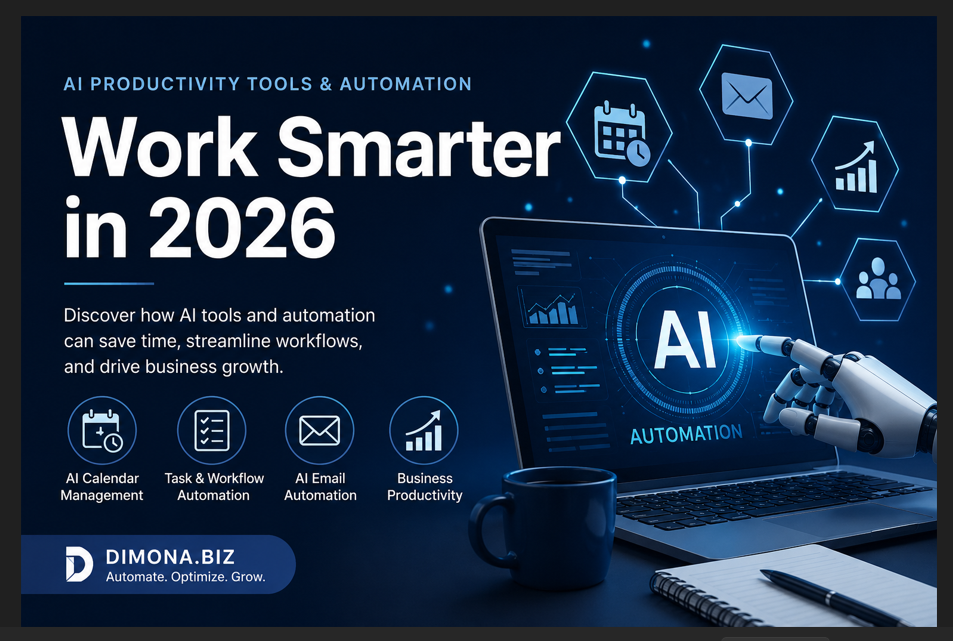
The Rise of AI-Powered Productivity
Businesses are constantly looking for ways to save time, reduce repetitive work, and improve productivity. In 2026, AI productivity tools and automation are becoming essential solutions for businesses that want to work smarter without continuously increasing their workload.
From managing calendars and emails to automating customer follow-ups and organizing daily tasks, artificial intelligence can handle many routine processes that previously required hours of manual work.
The biggest advantage is not simply doing tasks faster. AI can help businesses create more efficient workflows, reduce administrative work, and allow employees to focus on higher-value activities.
Here are four practical ways businesses can use AI to improve productivity and automation.
AI Calendar Management: Make Scheduling Easier
Managing meetings and appointments can take more time than expected. Back-and-forth emails, scheduling conflicts, cancellations, and time-zone differences can quickly become an administrative burden.
AI calendar management tools can simplify this process by helping businesses coordinate appointments, identify available time slots, send reminders, and manage scheduling requests.
Instead of manually checking calendars and responding to every scheduling message, businesses can use AI-powered systems to automate much of the process.
Benefits of AI calendar management include:
- Automated appointment scheduling
- Calendar conflict detection
- Meeting reminders and notifications
- Reduced email communication
- Better time management
- Improved customer experience
For businesses that handle multiple appointments every day, automating scheduling can free up valuable time while reducing the risk of missed meetings.
AI-Powered Task Management and Workflow Automation
Managing daily tasks becomes increasingly difficult as businesses grow. Employees may spend significant amounts of time assigning tasks, updating project statuses, sending reminders, and following up on unfinished work.
This is where AI-powered task management and workflow automation can make a major difference.
AI tools can help organize tasks based on deadlines, priorities, and workflow requirements. Automated systems can also trigger actions when specific conditions are met.
For example, when a customer submits a form, an automated workflow could:
- Add the contact to a CRM.
- Assign the appropriate sales pipeline stage.
- Send a confirmation email.
- Notify a team member.
- Schedule a follow-up.
- Update the customer’s record.
This eliminates several manual steps from the process.
Why businesses are adopting workflow automation
Business automation can help reduce repetitive administrative work while creating more consistent processes. It can also help teams respond faster because important tasks and notifications can happen automatically.
The goal isn’t necessarily to replace employees. Instead, AI automation gives employees more time to focus on strategic work, customer relationships, and revenue-generating activities.
Automating Email Responses With AI
Email remains one of the biggest sources of repetitive work for many businesses.
Customer questions, appointment requests, lead inquiries, follow-ups, and internal communication can quickly fill an inbox.
AI-powered email automation can help businesses respond faster while maintaining a more personalized customer experience.
For example, an AI-powered system can analyze an incoming inquiry and determine whether it relates to:
- A sales question
- A support request
- An appointment
- A pricing inquiry
- A general question
- A follow-up request
The system can then trigger the appropriate response or route the conversation to the right team member.
AI email automation can help businesses:
- Respond to leads faster
- Send automated follow-ups
- Categorize incoming inquiries
- Reduce repetitive email work
- Improve lead nurturing
- Maintain consistent communication
For businesses that receive a large number of inquiries, faster responses can make a meaningful difference. A lead who receives a helpful response quickly is less likely to move on to a competitor.
Building an AI Productivity Stack for Your Business
Instead of relying on a single AI application, businesses can combine several AI productivity tools to create a connected technology stack.
A typical AI productivity stack might include:
AI Assistants
Used for research, content creation, brainstorming, summarization, and everyday administrative tasks.
CRM and Marketing Automation
Used to manage leads, automate follow-ups, organize customer information, and track sales opportunities.
Workflow Automation
Tools can connect different applications and automatically move information between systems.
AI Content Tools
AI can assist with blog posts, email campaigns, social media content, product descriptions, and other marketing materials.
Scheduling and Calendar Automation
Automated scheduling tools can reduce the administrative work involved in booking meetings and appointments.
The most effective approach is not to automate everything at once. Businesses should first identify repetitive processes that consume significant amounts of time and determine whether automation can improve them.
How to Choose the Right AI Productivity Tools
With hundreds of AI tools available, choosing the right technology can be overwhelming.
Before adopting a new tool, consider these questions:
What problem are you trying to solve?
Start with the business problem rather than the technology.
How much time does the task currently require?
Prioritize repetitive activities that consume hours every week.
Can the tool integrate with your existing systems?
A powerful AI tool is less useful if it cannot connect with your CRM, email platform, calendar, or other important applications.
Does it improve the customer experience?
Automation should make interactions easier and faster, not more complicated.
Can your team use it effectively?
The best tool is one that your team can actually implement and use consistently.
The Future of Business Productivity Is Automated
AI is changing the way businesses approach productivity. Instead of relying entirely on manual processes, companies can combine AI, automation, and smart workflows to create faster and more efficient operations.
From calendar management and task automation to AI-powered email responses and customer follow-ups, businesses have more opportunities than ever to reduce repetitive work.
The biggest opportunity isn’t simply using AI because it is popular. It’s identifying where your business loses time and using automation to eliminate unnecessary steps.
Businesses that start building smarter workflows today can create more efficient operations, improve customer experiences, and give their teams more time to focus on growth.
Ready to Make Your Business More Efficient?
Dimona.biz helps businesses explore practical ways to use AI automation, digital marketing, and technology-driven workflows to improve their operations.
Instead of spending hours on repetitive tasks, start identifying the processes that could be automated and build a smarter workflow around them.
Work smarter. Automate repetitive work. Focus on growth.
Comments are closed