
AI Weekly Insights
Friday, August 21, 2026
Dimona.biz Weekly AI & Productivity Insights
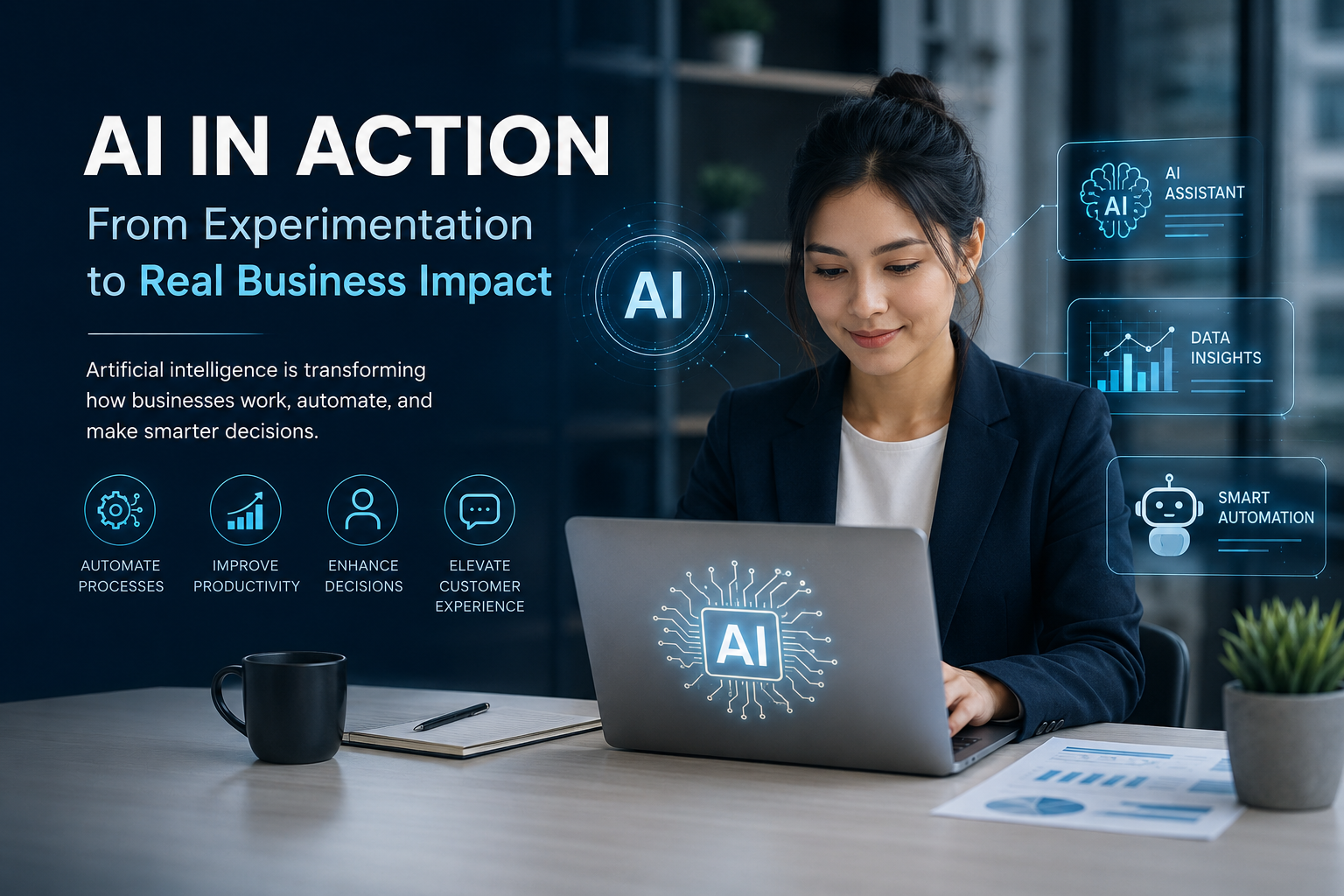
Welcome to this week’s AI insights from Dimona.biz. Artificial intelligence continues to move rapidly from experimentation into practical business applications. This week, we’re looking at how AI is changing everyday operations, the emerging technologies businesses should watch, and what industry trends could mean for the future of productivity and automation.
1. The Next Wave of AI Innovation: How Businesses Can Prepare
Artificial intelligence is entering a new phase. Instead of being viewed primarily as a tool for generating text or images, AI is increasingly becoming part of everyday business operations.
For small and mid-sized businesses, this shift creates an important opportunity. AI-powered software can now help automate repetitive processes, organize information, communicate with customers, and support employees without requiring a large technology department.
One of the biggest developments is the growth of AI-powered business automation. Companies can connect AI with their existing workflows to reduce manual tasks. For example, a business could automatically capture a new lead, analyze the inquiry, categorize the prospect, and trigger an appropriate follow-up sequence.
AI is also becoming easier for non-technical teams to use. Modern platforms increasingly provide simple interfaces, templates, integrations, and natural-language instructions. This means business owners can experiment with automation without necessarily needing to build complex systems from scratch.
Another important trend is personalization. AI systems can analyze customer information and help businesses deliver more relevant communication. Marketing teams can use AI to create personalized content, while customer service teams can use AI assistants to provide faster responses to common questions.
However, successful AI adoption is not about implementing as many tools as possible. Businesses should focus on identifying specific problems that AI can solve.
A practical starting point is to examine repetitive tasks that consume employee time every week. Data entry, appointment reminders, lead qualification, email organization, reporting, and content repurposing are examples of processes that may benefit from automation.
Businesses should then test one solution, measure the results, and improve the workflow before expanding.
The next wave of AI innovation will likely be defined by practical implementation rather than hype. Companies that learn how to integrate AI into their existing operations can improve efficiency while allowing employees to focus on higher-value responsibilities.
2. Emerging AI Technologies to Watch in 2026
Artificial intelligence is developing across multiple areas, but several technologies are particularly relevant for businesses looking to improve productivity and customer experiences.
One of the most important developments is the rise of AI agents. Traditional automation typically follows predefined rules. AI agents can go further by interpreting information, determining the next appropriate action, and completing multiple steps within a defined workflow.
For example, an AI agent could receive a customer inquiry, determine what the customer needs, check available information, and direct the request to the appropriate department. With proper controls and human oversight, these systems can reduce the amount of manual work required for repetitive processes.
Another technology gaining attention is AI-powered customer service. Businesses are using conversational AI to answer frequently asked questions, provide basic support, schedule appointments, and qualify leads. Instead of replacing human employees, these systems can handle routine interactions while allowing staff to focus on more complicated customer needs.
AI-powered data analysis is another area worth watching. Businesses generate enormous amounts of information through CRM systems, websites, marketing campaigns, sales platforms, and customer interactions. AI can help turn that information into useful summaries and insights much faster than traditional manual analysis.
Generative AI is also becoming more useful beyond basic content creation. Businesses can use it for research, brainstorming, document analysis, email drafting, marketing campaigns, internal knowledge management, and content repurposing.
Meanwhile, AI integration is becoming increasingly important. The real value of AI may not come from using a single tool but from connecting multiple systems into a coordinated workflow.
For example, a CRM could work together with an AI assistant, email platform, calendar, and reporting system. When these tools communicate effectively, businesses can create automated processes that operate with less manual intervention.
Despite these advancements, businesses should approach emerging AI technologies carefully. Security, privacy, accuracy, and human oversight remain important considerations.
The goal should be to select technologies that solve measurable business problems rather than adopting tools simply because they are new.
For companies exploring AI in 2026, the best strategy is to start with a specific business need, test the technology, measure the results, and scale successful implementations.
3. AI Predictions from Industry Leaders: What the Future Could Look Like
The rapid development of artificial intelligence is changing expectations about how businesses operate. While the exact future of AI is difficult to predict, several trends suggest that automation, intelligent software, and AI-assisted decision-making will become increasingly common.
One likely development is the continued growth of AI-powered workflows. Businesses are moving beyond using AI as an isolated productivity tool and are beginning to integrate it directly into their operational systems.
This could mean AI becoming part of sales, marketing, customer service, administration, finance, and project management workflows.
Another major trend is the development of more capable AI assistants and agents. Instead of simply answering questions, future AI systems will increasingly be expected to complete tasks. They may help research information, prepare reports, organize customer data, monitor workflows, and recommend next steps.
This could significantly change how employees interact with business software.
AI is also expected to become more personalized. Businesses may increasingly use AI to understand individual customer needs and deliver more relevant experiences. Marketing campaigns, customer communications, product recommendations, and support interactions could all become more tailored to individual users.
At the same time, human oversight will remain essential.
As AI becomes more capable, businesses will need clear policies around how automated systems are used. Employees will need to understand when AI can make decisions independently and when a human should review the result.
Another prediction is that AI skills will become increasingly valuable across almost every department. Employees won’t necessarily need to become AI engineers, but understanding how to work effectively with AI tools could become an important workplace skill.
Businesses may also shift their focus from simply asking, “Should we use AI?” to asking, “Where can AI create the most value?”
That change in mindset could be significant.
Rather than adopting AI because competitors are using it, businesses will increasingly evaluate automation opportunities based on measurable outcomes such as reduced operating costs, faster response times, improved customer experiences, and increased employee productivity.
The future of AI will ultimately depend not only on how advanced the technology becomes, but also on how effectively businesses implement it.
Companies that combine AI technology with strong processes, human expertise, and responsible oversight will be better positioned to take advantage of the next generation of business automation.
Stay Connected with Dimona
For more AI insights, business automation strategies, productivity tips, and technology updates, visit Dimona.biz.
Comments are closed