
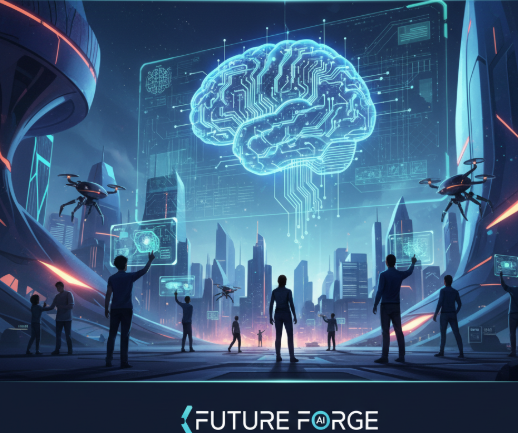
AI in 2030: What Today’s Businesses Must Prepare for Now

Artificial intelligence is no longer a future concept—it’s already shaping how businesses operate, compete, and grow.
By 2030, AI will move far beyond simple automation and become a core decision-making engine inside organizations. The question is no longer if AI will impact your business, but whether you’re preparing early enough to benefit from it.
AI Will Shift From Tools to Intelligence Systems
Today, many businesses use AI as a tool—chatbots, content generators, or basic automation. By 2030, AI will function as an intelligent system that connects marketing, sales, customer service, operations, and analytics into one unified brain. Businesses that prepare now will gain real-time insights, predictive decision-making, and automated execution across departments.
In the AI-driven economy, data is currency. Businesses that organize, protect, and leverage their data today will have a massive advantage tomorrow. AI thrives on clean, structured, and consistent data. Without it, even the most advanced AI tools will underperform.
Start preparing by centralizing customer data, tracking behavior across platforms, and investing in systems that integrate data rather than silo it.
Workforces Will Change—Not Disappear
AI in 2030 won’t replace humans; it will replace repetitive decision-making. Businesses must prepare their teams to work with AI, not compete against it. Roles will shift toward strategy, creativity, oversight, and relationship-building—while AI handles speed, scale, and optimization.
Companies that invest now in AI literacy and training will outperform those that wait.
Speed Will Become the Ultimate Competitive Advantage
AI-powered businesses will make decisions faster, personalize experiences instantly, and respond to customers 24/7. Companies that delay AI adoption risk falling behind competitors who can test, adapt, and execute in real time.
By 2030, slow decision-making will be a liability.
How Businesses Can Prepare Today
To stay competitive in the future of AI:
Adopt AI tools that integrate across departments
Build systems, not one-off automations
Train teams to collaborate with AI
Focus on long-term AI strategy, not short-term hacks
The businesses that prepare today won’t just survive AI in 2030—they’ll lead it.
👉 Curious how AI fits into your business?
Visit Dimona.biz to discover practical, real-world AI solutions designed for growing businesses.

Why Businesses Without AI Will Struggle to Survive the Next 5 Years
The business landscape is changing faster than at any point in history—and artificial intelligence is the driving force behind it. Over the next five years, AI won’t just be a competitive advantage. It will become the minimum requirement to stay relevant. Businesses that fail to adopt AI now will find themselves outpaced, outperformed, and eventually pushed out of the market.
AI Is Becoming the New Operating System for Business
AI is no longer a “nice-to-have” tool. It’s becoming the core operating system that powers marketing, sales, customer support, finance, and operations. AI-powered companies can analyze data instantly, automate workflows, and make smarter decisions at scale—something manual systems simply can’t match.
Without AI, businesses will struggle to keep up with speed, accuracy, and efficiency.
Customer Expectations Are Rising—Fast
Modern customers expect instant responses, personalized experiences, and 24/7 availability. AI enables businesses to meet these expectations through smart chatbots, automated follow-ups, predictive recommendations, and real-time support.
Businesses without AI will feel slow, outdated, and disconnected. And when customers have faster, smarter alternatives, loyalty disappears quickly.
Costs Will Rise While AI-Driven Competitors Scale
AI allows companies to do more with fewer resources. Tasks that once required entire teams—data analysis, lead qualification, content creation, scheduling—can now be handled by AI systems around the clock.
Businesses that rely only on manual processes will face higher labor costs, slower output, and shrinking margins, while AI-powered competitors scale faster and cheaper.
Decision-Making Without AI Will Become a Liability
AI doesn’t just execute tasks—it predicts outcomes. Businesses using AI can forecast trends, identify risks, and optimize strategies in real time. Those without AI will rely on delayed reports, gut instinct, and outdated data.
In the next five years, slow decision-making will cost businesses their market position.
The Businesses That Survive Will Adapt Now
Survival won’t depend on size—it will depend on adaptability. Businesses that start integrating AI today will be more agile, resilient, and future-ready.
AI isn’t replacing businesses. It’s replacing businesses that refuse to evolve.
👉 Start building your AI advantage today. Visit Dimona.biz and see how your business can grow smarter, faster, and stronger with AI.
The Dark Side of AI’s Future Nobody Likes to Talk About
Artificial intelligence is often framed as a silver bullet—faster growth, lower costs, smarter decisions. While those benefits are real, there’s a side of AI’s future that few businesses openly discuss. Ignoring it doesn’t make it disappear. In fact, it makes the risks far greater.
Understanding the dark side of AI isn’t about fear—it’s about responsible preparation.
Over-Automation Can Strip Away Human Judgment
AI excels at speed and pattern recognition, but it lacks human context, empathy, and ethical reasoning. Businesses that blindly automate decisions risk creating systems that feel cold, unfair, or even harmful to customers.
When AI replaces judgment instead of supporting it, trust erodes. The future belongs to businesses that combine AI intelligence with human oversight, not those that remove people entirely from the process.
Data Dependence Creates New Vulnerabilities
AI systems are only as good as the data feeding them. Poor-quality data leads to poor decisions—at scale. Worse, heavy reliance on data opens doors to privacy breaches, compliance risks, and reputational damage.
As AI adoption increases, so does the responsibility to manage data ethically and securely. Businesses that fail to protect customer data will pay a far higher price than lost efficiency.
AI Can Quietly Widen the Competitive Gap
Large companies with resources can deploy advanced AI faster, leaving smaller businesses struggling to keep up. Without the right strategy, AI can increase inequality in markets instead of leveling the playing field.
The irony? AI has the power to empower small businesses—but only if it’s implemented strategically, not reactively.
Dependence on AI Can Weaken Core Skills
When teams rely too heavily on AI, critical thinking, creativity, and decision-making skills can decline. Over time, businesses risk becoming operators of tools rather than owners of strategy.
AI should augment human intelligence, not replace it.
The Real Risk Isn’t AI—It’s Unprepared Businesses
The biggest danger of AI’s future isn’t the technology itself. It’s businesses adopting AI without strategy, ethics, or long-term vision. AI magnifies whatever system it enters—good or bad.
Those who prepare responsibly will thrive. Those who rush blindly will struggle.
Ready to Use AI the Right Way?
AI doesn’t have to be risky when it’s built with intention.
👉 Start building your AI advantage today. Visit Dimona.biz
and discover how your business can implement AI systems that are smart, secure, ethical, and built for long-term success.
Comments are closed